The New Paradigm of Intelligence Triggers a Restructuring of Competition | 2025 China Intelligent Electric Vehicle Development Trend Insights - Issue One
The global automotive industry is undergoing a significant transformation that has not been seen in a century. The continuous innovation and rapid evolution of intelligence-related technologies are reshaping the automotive industry landscape and bringing a more profound impact on the transportation ecosystem. Today, "intelligence" has become an important product characteristic of cars that cannot be ignored and is the "battlefield" for automotive manufacturers to compete in terms of technological strength.
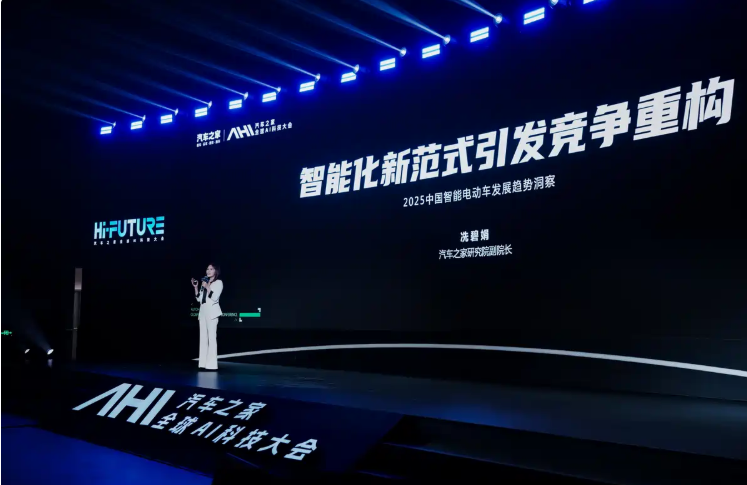
On September 21, at the "Auto Home Global AI Technology Conference," Xian Bijuan, Deputy Director of the Auto Home Research Institute, released the report titled "The New Paradigm of Intelligence Triggers a Restructuring of Competition - 2025 China Intelligent Electric Vehicle Development Trend Insights." Based on industry observations, data from Auto Home's vehicle database, and tracking of user needs, we have summarized and refined five core trends in the development of intelligence in China's electric vehicles and used Auto Home's AH-IT Intelligent Evaluation System to showcase the real intelligent experience of intelligent electric vehicles for users.
Driven by both the demand and supply sides,

The importance of intelligence continues to increase
Intelligence has become the primary reason for users to choose new energy vehicles instead of fuel vehicles. Three years ago, only 30% of users held this view, but now this proportion has increased to 73%, especially among mid-to-high-end users. It is evident that intelligence has become a "synonym" for new energy.
From the perspective of vehicle supply, both the standardization rate of intelligence in newly launched vehicles and the penetration rate of intelligence in vehicles on sale are increasing year by year. Especially under the industry trend of "intelligence driving rights," the standardization rate and penetration rate of L2-level intelligent driving assistance in new vehicles in 2025 have both increased by 10 percentage points, reaching 75% and 65% respectively, entering a new period of accelerated growth.
The penetration of specific configuration functions varies. In terms of intelligent cockpit functions, the penetration rate of interactive configurations has increased significantly: the penetration rate of voice zone wake-up and continuous voice recognition, which are responsible for interactive perception, has reached 70%; DeepSeek, which is responsible for interactive decision-making, and the central control screen, which is responsible for interactive feedback, have seen a rapid increase in penetration rates.
Intelligent driving assistance functions have entered a period of rapid popularization, with the annual penetration rate of multiple function configurations increasing significantly. Among them, the penetration rate of front perception cameras, lane centering, blind spot assistance, and DOW (Door Opening Warning) has accelerated, achieving mainstream status in 2025; the penetration rate of assisted parking has increased from 28.6% to 46.5%, with the largest increase among many driving assistance functions, and is expected to enter the mainstream in the second half of 2025.
Annual Trend One
"Intelligent Driving Rights" Fully Launched
At the beginning of 2025, under the joint promotion of automotive companies such as BYD, Changan, and Geely, "intelligent driving rights" came in full force. The price of models equipped with high-speed section driving assistance functions dropped below 100,000 yuan, and the price of models equipped with urban section driving assistance functions dropped below 200,000 yuan, promoting the penetration rate of high-speed and urban NOA in the low-price segment. According to Auto Home's big data, the penetration rate of intelligent driving assistance in the low-price segment below 200,000 yuan has increased rapidly. The penetration rate of models below 100,000 yuan has increased from zero to a certain level, and the penetration rate of models between 100,000 and 200,000 yuan has increased from 57% in 2024 to 73% in the first half of 2025. Of course, the penetration expansion of high-end models has not stopped either. Last year, intelligent driving assistance in high-end models above 400,000 yuan was still a lowland, but this year it has kept up with the development trend.

Under the education of the concept of "intelligent driving rights," users' attitudes have also changed significantly. More than 60% of users believe that high-speed section driving assistance should be a "basic configuration for mainstream models." Even among users below 200,000 yuan, 57% believe it should be a basic configuration. Similarly, urban section driving assistance is also the case, with nearly half of users believing it should be a basic configuration. Under such a perception, 60% to 70% of users said they might give up purchasing without high-speed and urban NOA and have a lower willingness to pay for optional configurations, making the possibility of commercial monetization even more remote.
Of course, there is still a glimmer of hope for high-end users. On the one hand, a higher proportion of high-end users believe that high-speed and urban NOA is "exclusive to high-end models," which can still be used as a functional point to achieve high-end differentiation; on the other hand, high-end users have a relatively higher willingness to pay, with 27% of users above 400,000 yuan willing to pay more than 5,000 yuan.
What has also changed is users' demand for test drives when purchasing a car. More users hope to experience intelligent driving assistance in daily usage scenarios. 72% of users hope to have a custom route function, such as a commute route test drive from home to the office, to test the usability of intelligent driving assistance, or they hope to experience test drives in complex traffic conditions to judge the credibility of driving assistance in extreme scenarios. At the same time, due to users' limited understanding of high-speed and urban NOA functions, nearly 60% of users hope to increase relevant function demonstrations and training during the test drive and purchase process.


